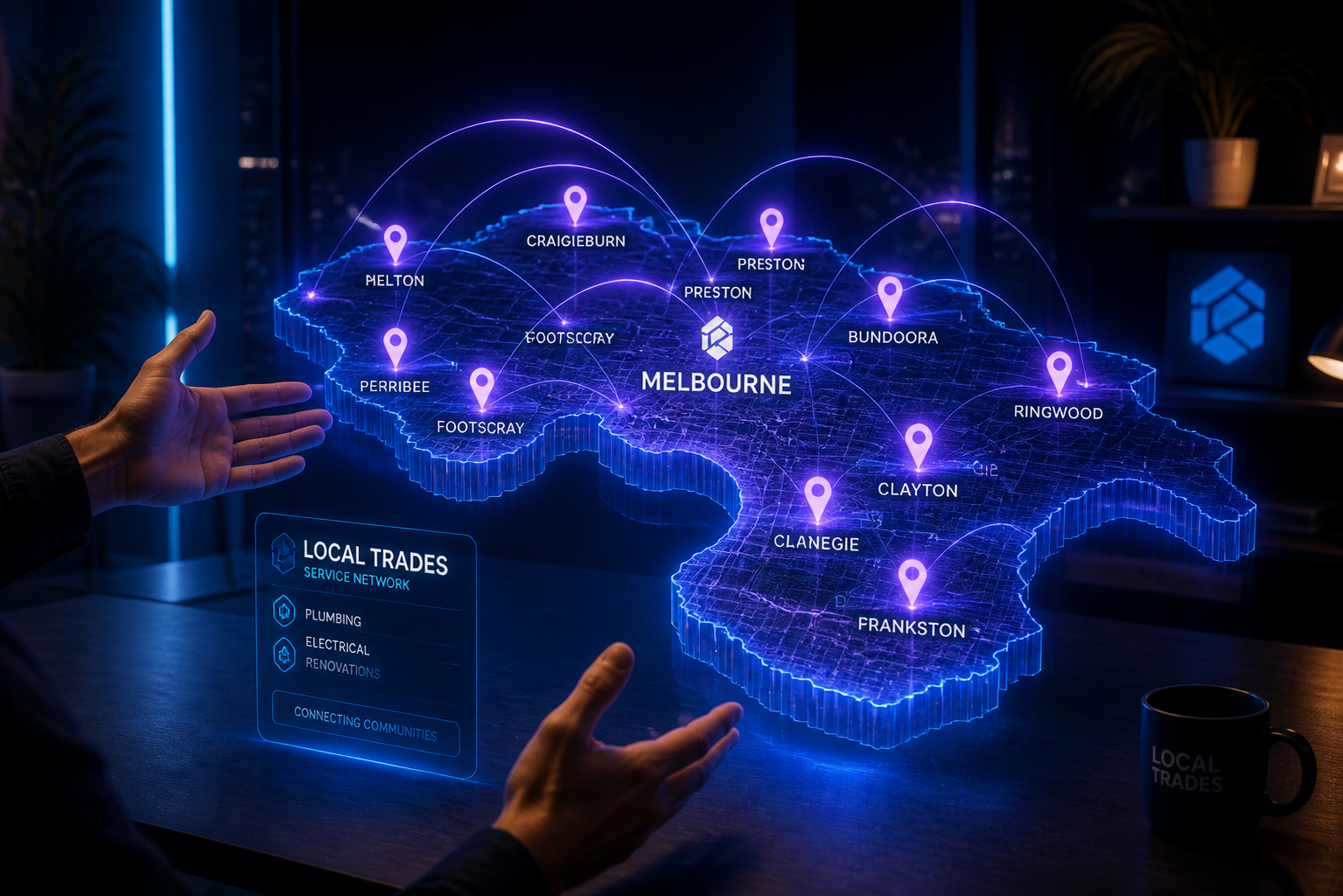
If you run a small business in Melbourne, appearing in local Google searches isn't optional — it's survival. When someone searches "plumber near me" or "web designer Dandenong," Google decides which businesses appear in the map pack and organic results within seconds. The difference between position 1 and position 10 can mean thousands of dollars in monthly revenue. This is your complete guide to winning at local SEO in Melbourne.
What Is Local SEO and Why Does It Matter for Melbourne Businesses?
Local SEO (Search Engine Optimisation) is the practice of optimising your online presence to attract more business from relevant local searches. Unlike general SEO, which targets national or global audiences, local SEO focuses on customers in specific geographic areas — suburbs, councils, or city regions.
For Melbourne small businesses, local SEO is uniquely important because:
- 46% of all Google searches are seeking local information
- 78% of local mobile searches result in an offline purchase or contact within 24 hours
- Melbourne's suburban sprawl means customers search by suburb ("accountant Berwick") not just city ("accountant Melbourne")
- Local search results have less competition than national rankings
- It's free — unlike Google Ads, organic local rankings don't charge per click
1. Claim and Optimise Your Google Business Profile
Your Google Business Profile (GBP) is the single most important asset for local SEO. It's what appears in Google Maps, the Local Pack (the map with 3 business listings), and Google Search knowledge panels.
Complete Every Field
- Business name (exactly as it appears in the real world — no keyword stuffing)
- Primary and secondary categories (be specific: "Electrician" not just "Contractor")
- Full address and service areas (add every suburb you cover)
- Hours of operation, including holiday hours
- Phone number and website URL
- Business description (750 characters — use keywords naturally)
- Attributes (women-led, LGBTQ+ friendly, wheelchair accessible, etc.)
- Products and services with descriptions and prices where applicable
Add Photos Weekly
Businesses with 100+ photos get significantly more engagement than those with fewer. Add photos of:
- Your storefront or office exterior
- Team members and behind-the-scenes shots
- Products, services, and completed work
- Interior spaces
- Vehicles and branded uniforms
Post Updates Regularly
Google Posts are free mini-ads that appear in your GBP. Post weekly about offers, events, new services, or seasonal reminders. This signals to Google that your business is active and relevant.
2. Build Local Keyword Pages on Your Website
Google ranks website pages for specific keywords. If you want to rank for "web design Dandenong," you need a page specifically about web design in Dandenong. This sounds obvious, but most Melbourne small businesses try to rank their homepage for every term.
Keyword Research for Melbourne Suburbs
Start by identifying the search terms your customers actually use. Tools like Google Keyword Planner, Ubersuggest, or Ahrefs can help, but you can also use common sense:
- [your service] + [suburb] (e.g., "cleaner Narre Warren")
- [your service] + "near me" (e.g., "dentist near me")
- [your service] + "Melbourne" (e.g., "solicitor Melbourne")
- Emergency/urgent + [service] (e.g., "emergency plumber Frankston")
- Best/top + [service] + [area] (e.g., "best cafe Berwick")
Our Melbourne web design team builds suburb-specific landing pages for clients across Dandenong, Narre Warren, Berwick, and beyond. Each page targets a specific local search term with unique, useful content.
3. Ensure NAP Consistency Across the Web
NAP stands for Name, Address, and Phone number. Google cross-references your NAP across hundreds of directories and websites to verify your business legitimacy. Inconsistent information confuses Google and hurts rankings.
Audit your NAP on:
- Your website (header, footer, contact page)
- Google Business Profile
- Facebook Business Page
- Apple Maps, Bing Places, Yelp, True Local
- Industry-specific directories (Hipages, OneFlare, Airbnb, etc.)
- Local council business directories
Even small differences matter. "123 Main St" vs "123 Main Street" or "Suite 5" vs "Ste 5" can dilute your authority. Pick one format and use it everywhere.
4. Earn and Manage Reviews Strategically
Reviews are a top-three ranking factor for local SEO. They also heavily influence customer decisions — businesses with 4.5+ stars and 30+ reviews convert significantly better than those without.
How to Get More Google Reviews
- Ask every satisfied customer immediately after service completion
- Create a simple review link (use Google's review link generator in your GBP dashboard)
- Send follow-up SMS or email with the direct link 24–48 hours after the job
- Make it easy: one tap, no login required
- Train your team to mention reviews as part of their close
- Respond to every review, positive and negative, within 24–48 hours
Never buy fake reviews or offer incentives in exchange for reviews — both violate Google's policies and can result in profile suspension.
5. Build Local Citations and Backlinks
Citations are mentions of your business NAP on other websites. Backlinks are links from other websites to yours. Both signal to Google that your business is real, established, and trusted in the local community.
Melbourne Citation Sources
- Yellow Pages Australia
- True Local
- StartLocal
- Word of Mouth Online (WOMO)
- Industry-specific directories
- Local Chamber of Commerce listings
- Casey, Knox, and Frankston council business directories
Local Link Building Strategies
- Sponsor local sports teams or community events and get listed on their websites
- Partner with complementary local businesses for cross-promotion
- Get featured in local news (send press releases about milestones or community involvement)
- Write guest posts for local business blogs
- Create genuinely useful local resources (e.g., "Ultimate Guide to Renovating in Casey")
6. Add Local Business Schema Markup
Schema markup is structured data code that tells Google exactly what your business is, where it's located, what it does, and how to contact you. It's invisible to visitors but powerful for SEO.
For Melbourne small businesses, implement:
LocalBusinessschema with your trade type (e.g.,Plumber,Electrician,ProfessionalService)GeoCoordinateswith your latitude and longitudeOpeningHoursSpecificationfor each dayAggregateRatingif you have review dataAreaServedlisting every suburb you cover
Every website we build includes complete local business schema as standard. It's a small technical detail that delivers outsized ranking benefits.
7. Optimise for Mobile and Page Speed
Over 70% of local searches happen on mobile devices. If your site is slow or hard to use on a phone, Google ranks you lower and visitors leave before contacting you.
- Aim for under 3-second load time on 4G connections
- Use large, thumb-friendly buttons and tap-to-call links
- Keep forms short and easy to complete on small screens
- Avoid intrusive popups that cover content on mobile
- Use Google's Mobile-Friendly Test and PageSpeed Insights regularly
8. Create Location-Specific Content
Beyond suburb landing pages, create blog posts and resources that demonstrate local expertise. This builds topical authority and earns natural backlinks.
Examples for different industries:
- "5 Things to Know Before Renovating in the City of Casey"
- "Best Cafes in Berwick for Business Meetings" (for a B2B service)
- "How Flood-Prone Areas in Dandenong Affect Plumbing Choices"
- "Solar Panel Regulations in Knox Council: What Homeowners Need to Know"
How Long Does Local SEO Take to Work?
Realistic timelines for Melbourne small businesses:
- Google Business Profile improvements: 2–4 weeks
- Suburb page rankings: 6–12 weeks (low competition), 3–6 months (high competition)
- Review-driven ranking boosts: 4–8 weeks
- Citation and backlink impact: 2–4 months
Local SEO compounds over time. The businesses that commit to consistent effort see exponential returns in months 6–12.
Need Help With Local SEO in Melbourne?
Local SEO is complex, time-consuming, and constantly evolving. As a Melbourne web design and SEO agency, we handle the technical work so you can focus on running your business.
Our local SEO services include Google Business Profile optimisation, citation building, review management systems, suburb page creation, schema markup, and monthly reporting. Get a free local SEO audit and see exactly where your business ranks and what's needed to outrank your competitors.